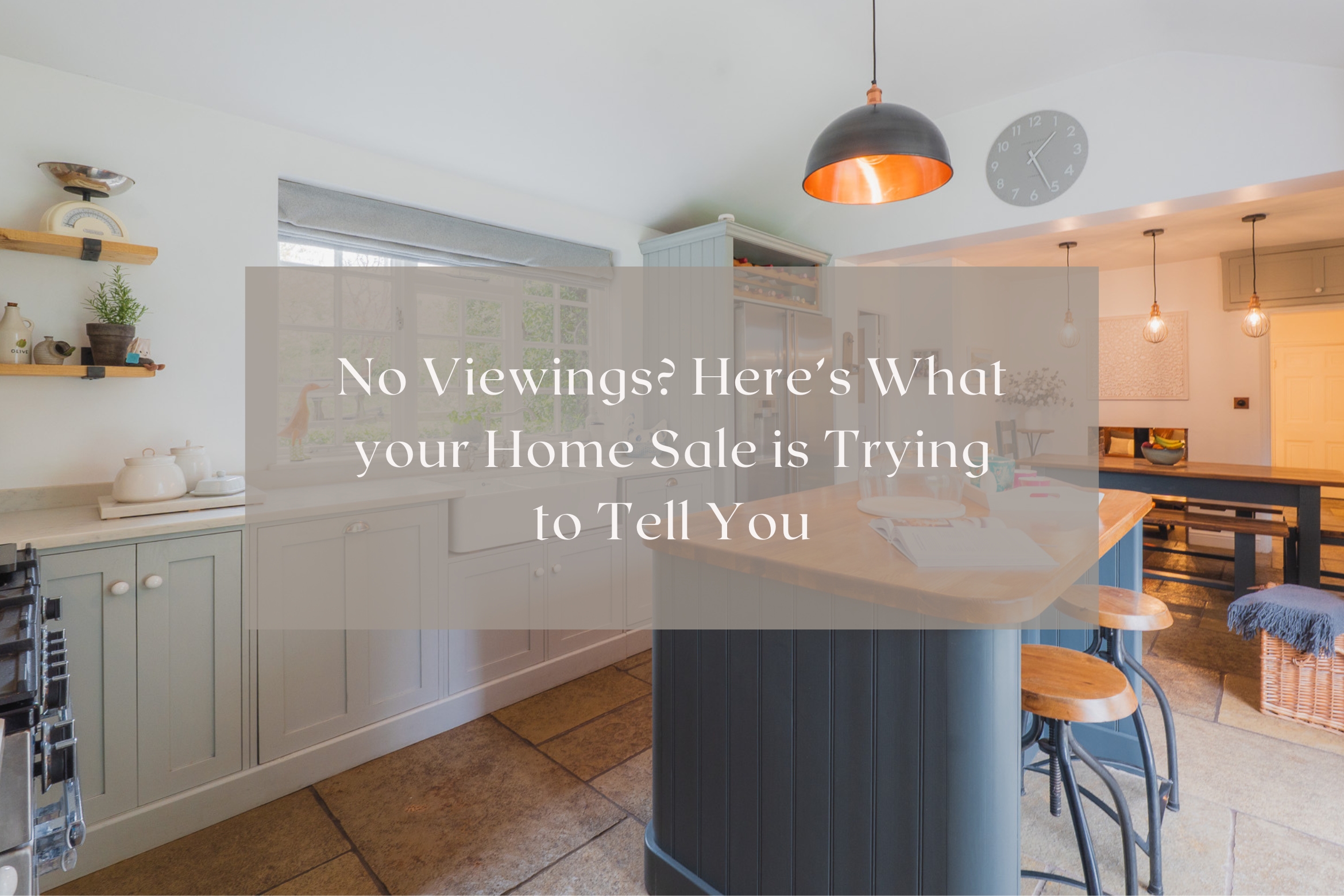


It’s a position no one ever wants to find themselves in, when selling their home. After weeks, if not months, of careful liaising with estate agents, visits from EPC assessors, photographers, videographers, home stylists, viewing specialists, valuations, decluttering, touching up, wiping down and cleaning every inch of the home to a sparkle. The proverbial red carpet is laid out, the fire is lit, you’re ready to receive and then…nothing.
Silence.
It can feel devastating, and it’s so difficult not to take the lack of viewings personally. No doubt friends, family and possibly also your estate agents will be full of platitudes along the lines of “It’s a quiet market, things will pick up soon” or “The right buyer will fall in love with your home on first sight…they’ve just not come along yet”, and while yes, these statements might have some truth to them, there is another that those close to you have trouble saying: If your home has been on the market for weeks and nobody is booking a viewing, this isn’t your home going unseen, it’s your home going overlooked. It’s time to keep a level head and assess the situation. The first step in rectifying this is to ask why?
Here’s what to do when you’re not getting viewings:
1. Ask to look at the data
If your home isn’t attracting viewings, the first question is whether buyers are actually seeing it in the first place. Ask your agent for the performance data behind your listing. How often is it appearing in searches? More importantly, are buyers clicking through to take a closer look?
If plenty of people are seeing the listing but very few are engaging, the issue may be presentation rather than the property itself. The lead image, pricing, headline and overall positioning all play a part in that split-second decision to click or scroll on.
Getting clicks but no viewings? This suggests buyers are interested enough to look, but just not convinced enough to take the next step and see it in person. That’s where the real detective work begins. If people are clicking through but not booking a viewing, something in the detail is causing hesitation. It may be the price. It may be the something related to the photography – even the lighting – or a floorplan that is difficult to understand. Perhaps the description undersells the price tag and fails to capture the behind-the-scenes upgrades that make the home so unique. Sometimes, the reason for a lack of viewings lies in the follow-up; in a buyer’s market, if enquiries aren’t handled quickly or persuasively, interest can evaporate as quickly as a passing rainbow.
Once you understand the data, like a flow chart, you’ll have a good idea of where to go next. Finally, it’s worth asking a more useful question: where exactly are buyers dropping off?
1. Review your asking price
Considering a home’s price as a static, immovable figure is a bit like throwing a paper aeroplane towards a dartboard; its flightpath is affected by all sorts of outside forces, and the chances of it landing on exactly the same number twice are slim. Interest rates vary, competing homes appear, buyer confidence rises and falls almost weekly. A price that felt perfectly reasonable a matter of weeks ago can drift out of alignment with the market changes happening around it.
Reconsult with your estate agent (or indeed several) and adjust the price if necessary, making sure to make the price change meaningful enough for buyers to notice according to portal search engines.
2. Fix the first impression
Unless your buyer happens to stroll by the For Sale sign at the end of your driveway, the first viewing happens online. If your listing has been live for a while, take an honest look at the photography – particularly the lead image.
The opening image should capture the home from outside, however, an outside shot showing bare, leafless trees and leaden winter skies will feel oddly discordant to those viewing a house in spring or summer, subliminally hinting at a home that has lingered on the market too long.
It takes seconds to form a first impression, and this first impression then births secondary impressions such as “if it’s been on the market this long, I wonder what is wrong with it?”, “it’s clearly overpriced if it’s still on the market”.
Even if the photography is in keeping with the season, it’s well worth reshuffling the order of photography to avoid those who may have seen your home previously, but not clicked further automatically, from scrolling by.
A refresh with current photography, stronger lead images or even a fresh set of pictures can help put the home back in front of buyers with fresh eyes.
3. Sell the lifestyle
If your home still isn’t attracting viewings, ask yourself another question: is the marketing underselling it?
In the modern era, premium presentation is no longer an optional extra reserved for country estates and seven-figure homes. Buyers at almost every level now expect aspirational marketing, both in photography and copy, driven largely by the lifestyles we see showcased on social media. Nowhere is this more important than in homes of a higher value, where buyers are looking beyond the bricks and mortar and where in certain circumstances people are relocating and looking to buy a version of the life they imagine themselves living.
Begin by reviewing your photography. Here, it pays to be ruthless and ensure that there are no poor weather shots, gloomy interiors, pictures of cluttered kitchens or bedrooms (pay attention to cupboard tops and coats hanging behind doors in hallways). Tight-angle photography can be equally as damaging. While a utility room or laundry can be a vital asset of a home, if a room feels cramped in photographs, buyers will often assume it feels even smaller in reality. In some cases, it is better not to photograph a difficult room at all than to present it badly.
Twilight photography is fast becoming an essential part of marketing for sellers, while for those with land or situated in rural landscapes or nestled in Areas of Outstanding Natural Beauty, drone imagery is a must. Mobile phone photography is simply unacceptable at this level, as is poor editing with washed out colours.
Photography paints half the picture; words fill in the blanks. Weak descriptions can also play their part in failing to convert portal surfers to in-the-flesh viewers.
The formula here is to seamlessly blend key practical details with the essence and lifestyle the home encapsulates. Where pictures evoke mood, the same must be said for the copy; it must excite and entice a person into making that phone call and booking that viewing in order to see this magic for themselves. Every home has a kitchen, but not every kitchen is the life and soul of the party, with a bespoke breakfast bar precision positioned to capture the morning sunrise over the fields beyond the bifolding doors.
Scour your descriptions for empty adjectives that are taking up valuable character space while adding nothing to the description, words so over-used in estate agency they have become devoid of all meaning such as ‘exceptional’, ‘rare opportunity’, ‘stunning’ and the worst offender of all… ‘boasting’.
4. Ask your agent to share their strategy
When viewings fail to materialise, the question most sellers eventually arrive at is this: Is my agent actually doing enough?
Not everyone feels comfortable voicing this question, particularly homeowners who have a good relationship with their estate agent, or if you have already invested time, money and trust into the relationship, but it is an important and necessary question to ask.
Questions to ask might include the following:
– What specific steps are you currently taking each week to generate new interest in the property?
– How many buyers from your database have you personally contacted about this home?
– How are you actively prospecting for buyers?
– Are buyers giving any consistent feedback about price, presentation or location?
– How do you follow up enquiries?
– What form of social media marketing do you employ?
The type of response you get will help you understand whether your agent is the right one for your home. Answers that offer clarity and a vision for action might include the following:
– “We contacted seven buyers from our database this week who missed out on similar homes.”
– “The click-through rate is good, but buyers are dropping off after the third photo which suggests we might need to take some new angle photos of the kitchen.”
– “We think the exterior image is underperforming, so we’d recommend changing the lead photograph.”
– “We’re planning a targeted Instagram and Facebook campaign aimed at buyers relocating out of the city centre.”
Listing a property and actively selling a home are not the same thing and selling a higher-value home requires a certain level of understanding and experience and, to some degree, buyer psychology. A proactive estate agent will have already contacted you to update you with their findings, and crucially, their plan to get footfall through your front door.
Time to consider a re-launch?
After the time, money and effort you’ve invested in getting a home market-ready, one of the last things anyone wants to face is the decision to take a break from the market and relaunch.
Once a home has lingered too long online, even would-be buyers who once eyed it with curiosity and even longing begin to question its appeal, as subconscious assumptions about why it isn’t selling begin to assert themselves. Or, worse still, they scroll by without even noticing it at all.
This is the point where a full relaunch becomes the smart move. Fresh strategy, updated photography and creative, personal copy alongside presenter-led walkthrough videos and a strategic social media platform approach can help propel a home back into the limelight with renewed momentum.
When price, positioning and presentation all line up, no matter the market, the right agent can get the right viewers through the door, because a lack of viewings is rarely random.
Selling your home is an emotional process, even for the most pragmatic people, and following the effort it takes to get a home primed for photos, it’s easy to take it personally when the viewings don’t follow. The most important thing is not to panic, perception can be changed. Better photography, communicative, meaningful copy, a stronger launch strategy, refreshed marketing or even an adjustment in pricing can completely alter the way a home is seen. The hard truth is this: even the most beautiful of homes can go overlooked, but when a home is correctly positioned and marketed well, buyers rarely need persuading to book the viewing.
If you’re concerned about viewing figures, don’t panic: ask the important questions, review the data and challenge the marketing. And if you’re still concerned, it may be time for a fresh set of eyes. If you would like an honest assessment of why your home may not be generating the interest you’d hoped for, please don’t hesitate to contact us for an informal chat on 01829 700 359.
About the Author: Holly Goodenough | Creative Designer

Read More Articles
New Term, New Routine, New Home. Why September is the Month to Make your Move
There comes a point toward the closing stages of the summer holidays when the sadness of summer ending is finally outweighed by the promise of fresh starts, order, and the reestablishment of familiar routines when you relent to 

The Christmas Countdown Begins Around the BBQ
Unless you're from Australia, it's unlikely that where you'll be spending Christmas Day willcross your mind while you’re in the garden at 7pm checking on the smoker and topping up everyone's drinks on a warm August evening. The sun is shining, the steaks
Selling in Summer: Seven simple ways to keep your home viewing-ready
Summer is the selling season when it comes to homes. It’s textbook knowledge. From the hedgerows humming with birdsong, York stone patios glowing honey-gold in the sunshine, to the sweet scent of roses scrambling over walls and pergolas in the extended BST
New Term, New Routine, New Home. Why September is the Month to Make your Move
There comes a point toward the closing stages of the summer holidays when the sadness of summer ending is finally outweighed by the promise of fresh starts, order, and the reestablishment of familiar routines when you relent to
The Christmas Countdown Begins Around the BBQ
Unless you're from Australia, it's unlikely that where you'll be spending Christmas Day willcross your mind while you’re in the garden at 7pm checking on the smoker and topping up everyone's drinks on a warm August evening. The sun is shining, the steaks