


There is an unspoken moment at the start of every viewing. It happens before the kitchen, before the brochure, before the viewing agent has finished their first sentence – often before the buyer has even stepped out of their car.
An invisible stopwatch seems to hover. And then, imperceptibly, the clock starts.
In those first two minutes, buyers aren’t consciously analysing anything. They are just …reading the home. Not in analytical terms of features or floorplans, price bracket or extension potential, but in mood, light, flow and feeling.
Behavioural psychology has a name for this kind of rapid assessment – thin-slicing – the brain’s ability to form intuitive judgements based on very little information. Once that first impression is set, we tend to spend the rest of the experience seeking out the evidence to confirm it.
The concept is familiar, it’s exactly how we might read a room when we walk into a party, a job interview, a restaurant, or someone else’s house for the first time.
Psychological research suggests that these impressions can begin forming in as little as a fraction of a second – sometimes within just 100 milliseconds. This means that between the driveway and the doorway, something significant is forming in your viewer’s mind. Not yet a decision, exactly, but a leaning. Towards the possibility of an offer, or away from it.
Arrival: What does your home say without speaking?
Think about it for a moment. If first impressions are formed and embedded in the first 100 milliseconds, spending hours cleaning and styling your home to create a warm welcome are pointless if the outside doesn’t sing from the same hymn sheet. At this level of the market, buyers read arrival as a signal of lifestyle.
The driveway is the opening chord, setting the lifestyle tone for all that follows. What subliminal breadcrumbs can you scatter before they step inside that will help create that positive first taste?
Electric gates – do you leave them open and inviting or closed and secure? It depends upon the mood you want to create. Triple garage housing classic cars, perhaps it’s worth leaving it open to offer a glimpse into the lifestyle offered here. What do you already know about your viewer that can help you to lean into their way of life?
Jet washed pathways, neatly trimmed topiary, gravel neatly raked over for that optimum crunch. Play to each of the senses, after all, these are not practical details, they are emotional cues suggesting how the home might feel at the end of a long working day, or on a Sunday morning, or when friends come to stay.
The hallway: does your home know how to welcome?
Hallways are underestimated. So often consigned to a ‘just there’ sort of existence, yet, when it comes to viewings, they carry an enormous emotional load.
This is the moment where the home either opens its arms to embrace visitors or subtly holds back.
Buyers instinctively register ceiling height, light levels, temperature and space. Whether the eye is drawn forward into the home or stopped short by visual noise. While you can’t alter the proportions of your entrance hallway, you can certainly control the climate.
A tidy, clean home is de rigour for a viewing, but even the most minimal of clutter (an errant dog bed in a boot room) can often go overlooked and unseen. Anything that might interrupt the sense of flow can detract from a home’s positive first impression, however some elements can enhance it. For period homes fortunate enough to retain a fireplace in the hall, lighting it for a viewing is a must, creating the perfect warm welcome. At the opposite end of the spectrum a Scandi-style minimal entrance hallway with a tall vase of calla lilies brings an inherent sense of calm.
The light: the one thing that can’t be added later
Light is one of the few qualities buyers cannot renovate into a home. It either exists, or it doesn’t: and in the first two minutes, buyers are already registering it.
This extends beyond natural light (although cleanly polished mirrors and windows – both inside and out – are indeed essential). Lighting should enhance a room’s function, they directly correlate to whether or not rooms feel lifted or flat, warm or cool, open or enclosed.
Light is part of the luxury. Ensure soft lamps are on even during the day, particularly when it is dull. Opt for warm bulbs instead of cold. In corners that sit in shadow, add a standard lamp to bring warmth. Open plan family spaces are often designed to maximise light and views; so be sure to highlight any lighting features on a viewing.
It’s not about making the house brighter than it really is, but about shining light on its finest features.
The smell: the ultimate test
Olfactory sensation is the fastest way into the emotional brain, bypassing logic entirely. Unlike sight or sound, it connects directly to the amygdala and hippocampus, areas responsible for emotion and memory – which is why a single scent can instantly trigger a feeling, a place, or a moment from the past.
Researchers call this the Proust effect: the way smells awaken older, more emotionally charged memories than any other sense. These responses happen in milliseconds, often before we are consciously aware of them, directly impacting how safe, comfortable, or unsettled we feel in a space. Because of this, scent operates on both conscious and unconscious levels, influencing everything from perceived cleanliness to emotional openness. In a home, even the subtlest odour can colour the entire experience, long before buyers begin to analyse what they are seeing.
Interestingly, artificial air fresheners tend to work against the effect we may desire.
The most effective approach is usually the simplest: fresh air, clean fabrics, subtle natural smells. Coffee, clean laundry, a recently opened window.
The sound: an underrated luxury signal
Perhaps not the first thing that comes to mind when seeking to influence and impress a buyer, yet sound – or lack of it – plays a powerful role in how a home feels.
In the first moments of a viewing, buyers register background noise without consciously naming it, be it the passing sound of traffic, planes passing overhead, television blare from a neighbouring room, the bark of a dog.
Silence, or at least a sense of calm, can make all the difference. Let your home be a sanctuary. For family homes, asking a grandparent to walk the dog (and/or children) is an idea, simply to allow the viewer the chance to focus on the wonderful qualities of the home without background noise as a distraction.
Where preparation really counts
Most sellers prepare for viewings by spreading their attention evenly across the home: ovens are deep-cleaned, cupboards organised, spare rooms perfected and yet, many of these spaces will barely register in a buyer’s emotional memory.
It feels logical to make everything immaculate, but that isn’t how homes are experienced. People don’t absorb a home room by room, or detail by detail but in small moments, in how the spaces make them feel as they move through them.
In reality, we read a home in key places: the arrival, the hallway, the living room, the kitchen, the master bedroom and the key viewpoints that connect the house to its garden or setting. It is these spaces where buyers instinctively pause and take stock, where they begin to picture a version of their own life unfolding.
Buyers do not fall in love with floorplans; they fall in love with moments. And in those first two minutes of a viewing, buyers are not weighing up specifications or ticking mental boxes. They are asking something far simpler, and far more powerful: Could I belong here?
And long before they consciously realise it, the house – whether intentionally prepared or not – has already begun to answer.
About the Author: Holly Goodenough | Creative Designer

Read More Articles
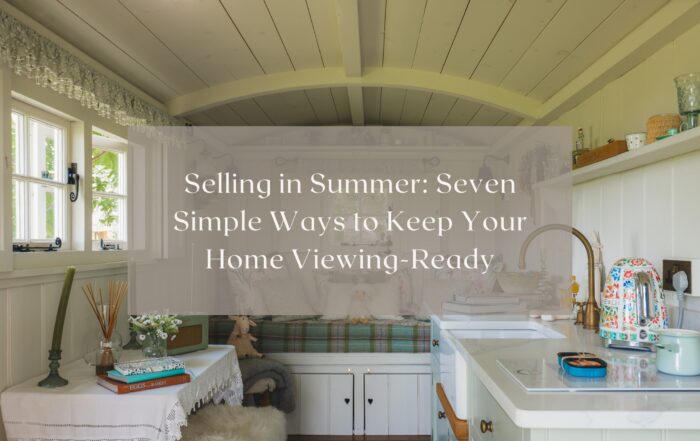
Selling in Summer: Seven simple ways to keep your home viewing-ready
Summer is the selling season when it comes to homes. It’s textbook knowledge. From the hedgerows humming with birdsong, York stone patios glowing honey-gold in the sunshine, to the sweet scent of roses scrambling over walls and pergolas in the extended BST 

No Viewings? What next?
It’s a position no one ever wants to find themselves in, when selling their home. After weeks, if not months, of careful liaising with estate agents, visits from EPC assessors, photographers, videographers, home stylists, viewing specialists, valuations, decluttering,

What is my home worth? Why the best agents won’t value your home
Have you ever given much thought to the expression “priceless”? It’s a fantastic oxymoron of a phrase, one we tend to reserve for those things we treasure above all others, moments or memories – perhaps
Selling in Summer: Seven simple ways to keep your home viewing-ready
Summer is the selling season when it comes to homes. It’s textbook knowledge. From the hedgerows humming with birdsong, York stone patios glowing honey-gold in the sunshine, to the sweet scent of roses scrambling over walls and pergolas in the extended BST
No Viewings? What next?
It’s a position no one ever wants to find themselves in, when selling their home. After weeks, if not months, of careful liaising with estate agents, visits from EPC assessors, photographers, videographers, home stylists, viewing specialists, valuations, decluttering,